An investigation by Baloo, Royal Investigator of Castle Whiskerton
The file landed on my desk shortly after breakfast. It was a thick file, marked URGENT, which immediately made me suspicious. In my experience, anything marked urgent has either been sitting unattended for three weeks or involves somebody else’s problem. I opened it with the caution such matters deserve and discovered a formal petition from the Fruit Oversight Committee requesting an immediate review of the pumpkin’s legitimacy as the undisputed star of Halloween.
I read it twice. A fruit committee challenging a pumpkin over Halloween celebrations was not something I had anticipated when I accepted my appointment as Royal Investigator of Castle Whiskerton. I have dealt with missing fish, suspicious portals, magical school dropouts and a goose who claimed diplomatic immunity after biting a visiting dignitary, yet nothing in my previous experience had prepared me for an agricultural constitutional crisis. The petition alleged that the pumpkin had enjoyed an outrageous amount of publicity without demonstrating that it deserved such prominence. Other fruits, the committee claimed, had been systematically overlooked, with the watermelon receiving a particularly pointed mention.
I made a note to investigate the watermelon later. First, I needed to establish how the pumpkin had acquired its position of influence in the first place.
1. Autumn, Harvests and the Cult of the Orange Sphere
Autumn is harvest season, when farmers gather the fruits of their labour and communities celebrate the abundance of the land before winter arrives. Across Europe, harvest festivals have long brought people together to celebrate food, local traditions and the changing seasons. Pumpkins and other squashes have become popular symbols of autumn, appearing in markets, kitchens, gardens and increasingly elaborate seasonal displays.
So far, the evidence appeared perfectly reasonable. Then I examined the annual pumpkin celebrations in Ludwigsburg, Germany, where the palace gardens are transformed into a spectacular exhibition devoted to the humble squash. Vast quantities of pumpkins, hundreds of varieties, enormous sculptures, culinary creations and competitions involving pumpkins of truly unreasonable proportions all feature in this seasonal extravaganza. There are pumpkin soups, pastries, sculptures and weighing championships, with the occasional pumpkin regatta thrown in for good measure. A regatta. A vegetable that grows on the ground has somehow persuaded humans to build boats out of it and race them.
I paused to consider this development. The pumpkin was no longer content to be harvested, cooked or displayed. It had apparently entered the world of competitive water sports, and I suspected the Fruit Oversight Committee might have a point.
Of course, autumn festivals are not exclusively about pumpkins. They celebrate the harvest as a whole, and the pumpkin happens to be particularly photogenic. Its cheerful orange colouring is practically designed for autumn decorations, while its generous proportions make it useful for feeding a crowd. Somewhere along the way, however, the pumpkin seems to have developed an opinion of its own importance. I decided that this was where the investigation became interesting.
2. From Harvest Basket to Haunted House
How did a respectable autumn vegetable become the unofficial mascot of Halloween? The answer involves older European traditions, folk beliefs, migration and a remarkable talent for publicity.
Long before the modern Halloween pumpkin became ubiquitous, people in parts of Ireland and Scotland carved faces into turnips and other root vegetables, sometimes placing lights inside them. These lanterns featured in folk customs associated with spirits, protection and the darker time of year. When Irish immigrants carried their traditions to North America, they encountered pumpkins, which were larger, readily available and considerably easier to hollow out than many turnips.
One can almost imagine the conversation. Someone suggests using a turnip, only to be reminded that the job will take all afternoon. Another person points towards an enormous orange pumpkin and proposes a more practical alternative. The rest, as they say, is history.
The pumpkin was ideally suited to the task. It had a generous interior, a flesh that could be carved and a surface large enough to accommodate a suitably alarming grin. The carved jack-o’-lantern gradually became one of Halloween’s most recognisable symbols, and the association spread through popular culture, decorations, advertising and the seasonal retail industry.
Today, pumpkins appear on doorsteps, in shop windows, on greeting cards and in photographs taken by people who seem to have discovered the only pumpkin in existence. I have seen enough evidence to conclude that the pumpkin’s rise to fame was not entirely accidental. Before allowing it to claim sole credit for Halloween, however, I needed to examine the German connection.
3. The German Connection (Because of Course There Is One)
By this point, I had exhausted the local archives, interrogated two suspicious gardening manuals and received absolutely no cooperation from the pumpkin in question. It was time to call in reinforcements. I dispatched ravens to my distant cousins in France and Germany, requesting historical intelligence on the pumpkin’s rise to prominence and any evidence of previous vegetable-related shenanigans.
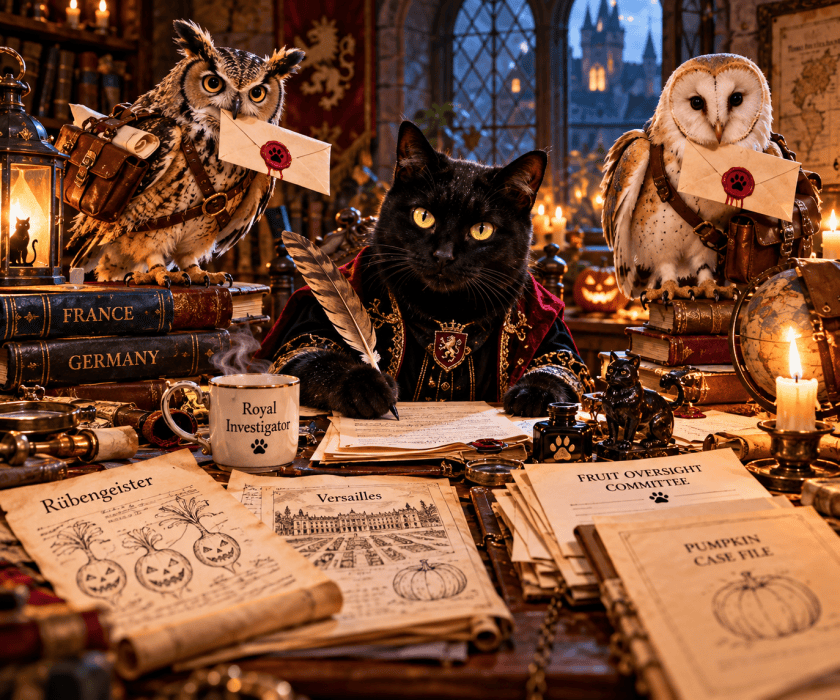
The response arrived by owlmail three days later. I should explain that owlmail is an ancient and highly respected communication system, favoured by those who appreciate discretion, reliability and the occasional opportunity to drop a heavy envelope on an unsuspecting recipient. The owl in question arrived without warning, deposited two substantial packets on my desk, scattered several pages across the floor and departed before I could ask whether a signature was required.
The French dossier contained information about a certain Monsieur Perrault, the royal gardens at Versailles and a pumpkin that had somehow secured a starring role in the Cinderella story. The German packet was considerably more intriguing, containing references to turnip spirits, carved vegetable lanterns and a tradition known as the Rübengeister.
Naturally, Germany had something to say about all this. In parts of southern Germany, the Rübengeister tradition involves hollowing out fodder turnips, carving grotesque faces into them and illuminating them with candles. The resulting creatures are not always pretty. Some have lopsided grins, enormous noses and expressions suggesting they have just discovered the annual heating bill. In certain regional traditions, children carried their illuminated turnip spirits from house to house, asking for food or small gifts.
The precise origins of these customs are not entirely clear, and regional variations matter. Some local accounts describe traditions shaped by harvest practices and periods of hardship, while the wider history of carved turnip lanterns is difficult to reconstruct with certainty. The important point for our investigation is that the pumpkin was not the first vegetable to discover that a hollow interior and a candle could produce a remarkably effective spooky face.
I also investigated whether the Rübengeister had Celtic or Druidic connections. One can hardly discuss autumn spirits without somebody invoking the ancient Celts, and Druids tend to turn up in these discussions with remarkable regularity. The Celtic festival of Samhain marked the transition into winter and forms part of the wider historical background to Halloween. Whether German turnip ghosts owe anything directly to Samhain or to Druidic rituals, however, remains unproven. The evidence does not establish a direct Celtic or Druidic ancestry for the Rübengeister, nor does it prove that the German and Irish-Scottish turnip-lantern customs developed from a single source.
A disappointing result for anyone hoping to discover that a Druid once stood in a field, hollowed out a turnip and accidentally invented Halloween. I must therefore record that the pumpkin was not the first vegetable to enter the spooky lantern business, although it has proved remarkably successful at convincing the public otherwise.
Perhaps the Fruit Oversight Committee should expand its investigation to include historical vegetable representation. There may be a case for compensation. I have also begun to wonder whether the watermelon has suffered a similar injustice. It is large, has a striking appearance and could presumably be hollowed out, although whether it would float is a separate matter that I am not prepared to investigate personally.
4. The Pumpkin: Celebrity or Simply Delusional?
Having established that the pumpkin enjoys an impressive seasonal career, I turned to its appearances beyond the harvest festival and the haunted doorstep. This is where matters became truly extraordinary.
Consider Cinderella. In Charles Perrault’s famous version of the fairy tale, published in 1697, the fairy godmother transforms a pumpkin into a magnificent carriage, enabling Cinderella to attend the royal ball. At midnight, the enchantment ends and the carriage returns to its original form, leaving Cinderella to deal with the consequences of a rather ambitious transportation arrangement.
Why a pumpkin?
My French cousins had supplied a particularly interesting lead. Perrault had connections to the world of Louis XIV and was familiar with the royal gardens at Versailles, where pumpkins were grown. Scholars have suggested that this familiarity may have influenced his choice, although no definitive explanation of his private reasoning survives. The transformation itself is wonderfully practical: the fairy godmother hollows out the pumpkin before turning it into a gilded coach. An ordinary garden vegetable becomes the starting point for something extraordinary.
The explanation is plausible, but I remain troubled by the selection process. A pumpkin is certainly large enough to accommodate a carriage, yet other fruits and vegetables might have been considered. A watermelon, for example, could have offered a more streamlined design, although the suspension system would require some thought. A pineapple would have been impractical, while a courgette would have been ridiculous. The pumpkin, however, gets the starring role.
Its literary career has since expanded into cinema, animation, family entertainment and seasonal advertising. Pumpkins have become shorthand for autumn, magic, mischief and the supernatural. Some achieve celebrity status without ever having to be carved, while others are transformed into elaborate decorations that appear to have required an engineering degree.
The pumpkin has crossed from agriculture into mythology, from mythology into entertainment, and from entertainment into mass merchandising. At this point, I must ask whether anyone has actually checked its credentials. The Fruit Oversight Committee’s petition may be less frivolous than it first appeared.
I am not suggesting that pumpkins have deliberately manipulated the public. I am merely observing that their rise to prominence has been astonishingly successful, while the watermelon remains largely confined to fruit salads and summer picnics. I consider this a matter worthy of further investigation.
5. The Great Pumpkin Question
I returned to the petition and reread the final paragraph. The Fruit Oversight Committee requested a formal determination of whether the pumpkin’s prominence in Halloween celebrations was justified by historical significance, practical suitability or simply an exceptionally effective public relations campaign.
I confess that I found the question difficult. The pumpkin has legitimate claims. It is a harvest crop, it is useful in the kitchen, it is easy to carve and it has become deeply embedded in modern Halloween traditions. Its popularity is not entirely without reason. The committee has nevertheless raised an important point: the pumpkin is not the only vegetable to have contributed to autumn folklore, nor is it the only fruit or vegetable capable of assuming a dramatic role. Somehow, it has secured the starring part.
I closed the file and recorded my preliminary findings. The pumpkin’s historical record is complicated, its cultural influence is undeniable, and its public relations strategy is frankly remarkable. Whether this makes it a legitimate Halloween celebrity or simply a delusional vegetable with an excellent agent remains unresolved.
I shall recommend that the Fruit Oversight Committee continue its work, preferably after lunch. Investigations of this magnitude require sustenance, and I have no intention of allowing the matter to interfere with second breakfast.
One final question remains, however, and I consider it the most pressing of all: how on earth did the obnoxious pumpkin manage to get itself written into fairy tales and eventually cast in movies?
I have no satisfactory answer. Perhaps the watermelon knows something.
Case status: Inconclusive. Further snacks required.
Baloo is the Royal Investigator of Castle Whiskerton. He welcomes evidence, suspicious vegetables and complaints about unfair representation. He does not welcome unsolicited fruit salads.
*Welcome to HAUNTVENT! If Christmas gets Advent, comprised of four weeks of build‑up, candlelight, and carols, why shouldn’t Halloween get its own countdown? Think about it. Even Thanksgiving has bonus add-ons such as Black Friday, Cyber Monday, Giving Tuesday. Oh, and let us not forget that Easter has the entire 40 days of Lent, plus Holy Week. Meanwhile, Halloween gets exactly one day. ONE! That’s like giving Christmas just one gingerbread man and calling it a holiday. We Halloween advocates deserve more. Want more. We have the right to Hauntvent. A full two weeks of delightful absurdity, seasonal satire, and spooky observations. In short, a playful countdown to October 31st. This October, I’m taking Halloween seriously. So buckle up, light your jack‑o’‑lanterns, and prepare yourself: Hauntvent has begun!

