
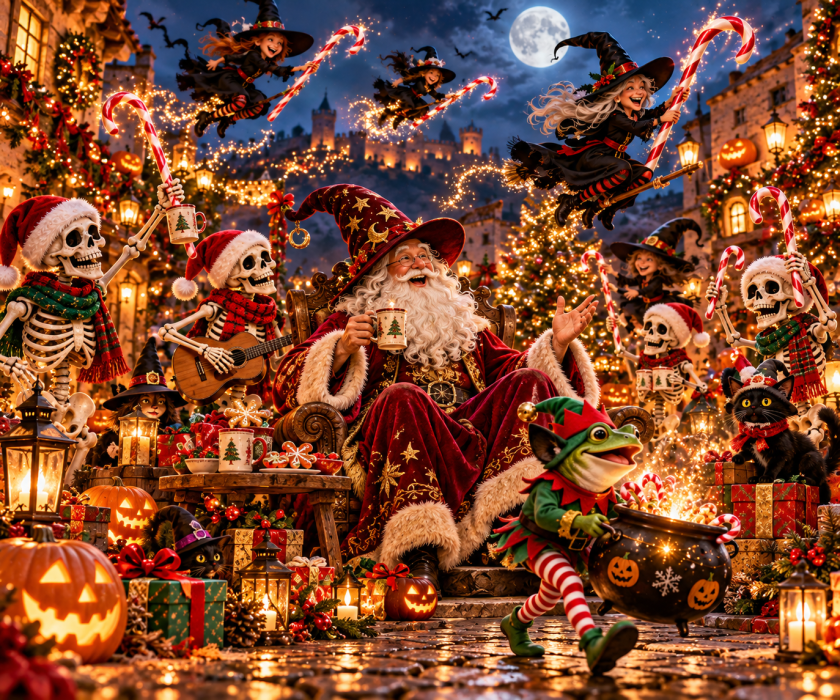
Once upon a time, holidays had boundaries.
Halloween occupied roughly one week of shelf space. Christmas arrived sometime in late November or early December. Stores displayed decorations appropriate to the season, children experienced anticipation, and pumpkins were generally allowed to complete their life cycle before encountering a snowman.
Those were simpler times.
At some point during the past decade, the retail calendar suffered what can only be described as a festive collision. Halloween and Christmas stopped existing as separate events and merged into a single commercial entity that now arrives promptly on September 1st. One moment you’re buying school supplies. The next, a twelve-foot skeleton is standing beside an inflatable Santa while “Thriller” competes with “Jingle Bells” over the store speakers. Plastic pumpkins share shelf space with reindeer. Witches browse alongside elves. Somewhere in the distance, a confused scarecrow wonders why it is surrounded by artificial snow.
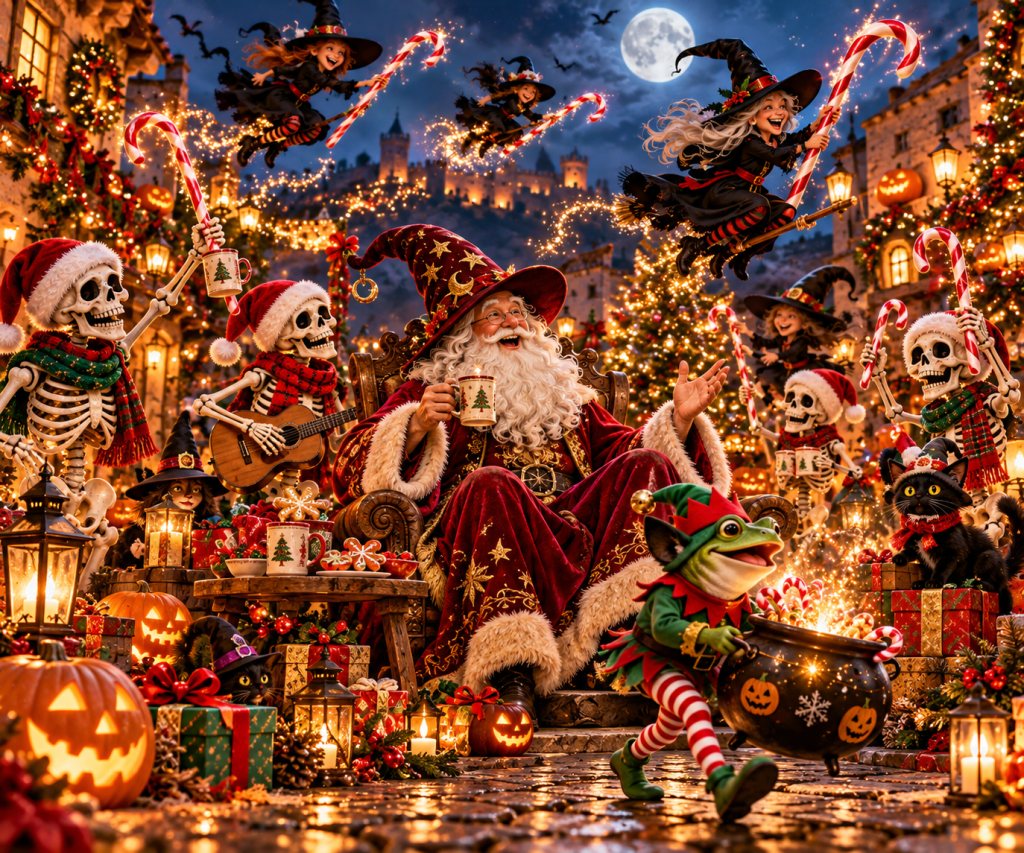
Welcome to Hallowistmas.
Nobody remembers exactly when it happened. One year Halloween decorations appeared a little earlier than usual. The following year Christmas crept forward as well. Retailers kept nudging the calendar until eventually September became a festive free-for-all where every holiday competes for attention simultaneously.
The phenomenon is particularly impressive across North, Central, and South America, where the final months of the year now resemble an Olympic relay race of celebrations. Halloween hands the baton to Día de los Muertos, which promptly passes it to Thanksgiving. Thanksgiving barely has time to sit down before Black Friday tackles it from behind. Cyber Monday arrives moments later, followed by Christmas shopping, Christmas parties, Christmas movies, Christmas markets, Christmas sweaters, Christmas sales, and Christmas-themed products that nobody requested but somehow now exist.
By the time Christmas Day actually arrives, many of us feel as though we have already celebrated it three times. The lights have lost their sparkle, the candy has long since been consumed, the turkey has made multiple appearances, and the credit card has entered a witness protection program. The festive spirit itself is lying face down on the sofa asking for a quiet cup of tea and perhaps a brief period without jingling bells.
Ironically, all this effort to maximize holiday excitement may be achieving the opposite effect. Anticipation used to be part of the magic. There was pleasure in waiting, in decorating gradually, and in allowing one celebration to finish before introducing the next. Today the calendar leaves little room for anticipation because every holiday arrives months before its official start date. When Christmas decorations appear in September, Christmas no longer feels special. It feels persistent. When Halloween begins before autumn has fully arrived, the season becomes less of a celebration and more of a long-term retail commitment.
Perhaps the greatest casualty of Hallowistmas is not our wallets but our sense of rhythm. Human beings have always marked time through seasons, festivals, harvests, commemorations, and celebrations. Each event had its place. Each occupied its own moment. Now they overlap like browser tabs left open by someone who insists they will definitely organize them later. The result is a strange cultural blur in which skeletons wear Santa hats, pumpkins sit beneath artificial snowflakes, and nobody is entirely certain which holiday they are currently preparing for.
Of course, social media occasionally redeems itself by producing moments of accidental genius. I spend a fair amount of time grumbling about algorithms, reels, and the general chaos of online life, but recently I stumbled across a video that made me laugh out loud. Someone had put up their Christmas tree in October and solved the seasonal overlap problem with remarkable efficiency. Rather than decorating it for Christmas immediately, they simply draped a white sheet over it and turned it into a ghost. Some versions apparently involve a witch’s hat. Halloween solved.
November arrives, the sheet comes off, and the same tree transitions effortlessly into Christmas mode. No additional purchases required. No seasonal identity crisis. Just one tree living its best multi-purpose life.
Naturally, this inspired a dangerous thought. Why stop there?
January arrives and everyone insists that decorations must come down after Three Kings. Must they, though? Easter is only a few months away. Remove the baubles, add some painted eggs, perhaps a few rabbits, and suddenly the tree has entered its spring phase. By this point the tree has evolved beyond mere decoration and become a year-round lifestyle choice. In a world where retailers are already trying to sell Christmas in September and Valentine’s Day before the Christmas leftovers are gone, perhaps the most rebellious act is not buying more decorations but demanding that existing ones work harder.
The more I thought about it, the more I admired the approach. While retailers are busy convincing us that every holiday requires a fresh collection of themed purchases, this lone tree quietly refuses to participate. The tree remains. The holidays rotate. Everybody wins.
Maybe that is the real lesson of Hallowistmas. The problem is not Halloween. The problem is not Christmas. The problem is not even the occasional vampire nutcracker, glitter-covered bat, or skeleton wearing a Santa hat. The problem is that somewhere along the way we stopped leaving space between celebrations. We became so busy preparing for the next holiday that we forgot how to enjoy the one currently happening.
Perhaps we simply need to reclaim a little breathing room. Let Halloween be Halloween. Let Día de los Muertos have its moment. Let Thanksgiving enjoy its turkey in peace. Let Christmas arrive when Christmas arrives. Let anticipation return to the calendar.
Until then, I will be over here admiring the ghost Christmas tree and wondering whether it might also work for Easter, birthdays, and the occasional Tuesday. If Hallowistmas is inevitable, we might as well make it efficient.
Happy Hallowistmas to all who celebrate.

