
24 July 2026
Most travellers only ever see one side of an airport. They arrive, check in, pass through security, board their flight and disappear into the sky. Spending an entire night inside Madrid’s Terminal 4 offered a very different perspective. Airports don’t simply close when the last departure leaves. They slip quietly into what I came to think of as night mode.
Between midnight and five in the morning the entire building seems to exhale. The departure boards continue to glow, the cafés remain open and the occasional traveller wanders past with a suitcase in tow, but everything moves at half speed. Announcements become infrequent, conversations soften and the bright bustle of daytime gives way to an unexpected calm.
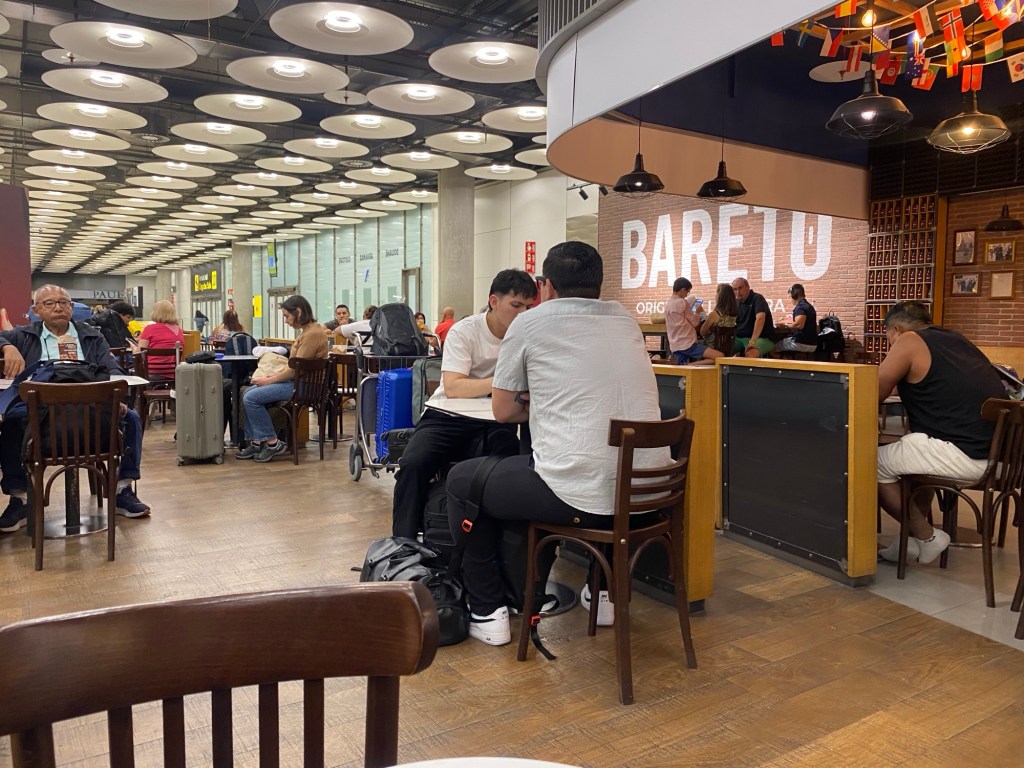
The twenty-four-hour café became my headquarters for the night. I never actually left it, although I did change tables after a while. My original seat came with complimentary entertainment. On one side, Colombian and Mexican migrant workers cheerfully trash-talked each other for hours. On the other, a Peruvian woman appeared to be conducting a three-hour performance review of her husband over the telephone. Whether he deserved it remains unknown, but eventually I decided to relocate before I accidentally became part of the conversation.
A fresh table deserved a fresh start. After another quick visit to the wonderfully empty bathrooms, I settled down with a freshly baked croissant, freshly squeezed orange juice and a cappuccino strong enough to wake the dead.
One unexpected discovery was the airport bathrooms during the small hours of the morning. Between midnight and dawn they smelled of jasmine and freshly mopped floors, almost spa-like in their cleanliness. I knew the moment was fleeting. A few hours and several thousand passengers later, that delicate fragrance would inevitably give way to the familiar scent of coffee, deodorant, tiredness and travel. Airports, like cities, have different aromas depending on the hour of the day.
Watching fellow overnight travellers was almost as entertaining as people-watching in any town square. Some brave souls had stretched out on the polished floor with nothing more than a jacket for a pillow. Even more astonishing, many of them woke looking remarkably refreshed, as though they had spent the night in a five-star hotel rather than beside Gate H27. I have accepted that I will probably never evolve into that particular species of traveller. Café catnaps appear to be my natural habitat.
By three o’clock the airport quietly began preparing for the day ahead. Cleaning crews appeared almost as if on cue, polishing floors, emptying bins and working around sleeping passengers with remarkable consideration. Nobody was disturbed unnecessarily. The staff simply carried on with their work, allowing everyone to squeeze whatever rest they could from an uncomfortable night.
People often say airports never sleep, and after spending the night in one I can confirm that they are absolutely right, although perhaps not in the way we imagine. Even while passengers doze, the terminal quietly keeps itself alive. Café staff prepare breakfast, maintenance crews move almost invisibly through the building, security officers continue their patrols and information desks remain staffed throughout the night. One feature I particularly appreciated was the dedicated assistance area for passengers with reduced mobility and older travellers travelling alone. Complete with its own concierge service, it operates around the clock, and at two o’clock in the morning the staff were unfailingly cheerful while pointing me in exactly the right direction. It’s one of those thoughtful services that many people will never notice unless they need it, but knowing it exists says a great deal about the airport.
Around five o’clock the transformation began. One reason the terminal suddenly springs back to life is that many European airports operate under overnight noise restrictions, limiting scheduled aircraft movements to reduce disturbance for surrounding communities. Once those restrictions end, the first wave of arrivals and departures begins almost simultaneously. Within minutes the quiet halls fill with rolling suitcases, cheerful reunions, bewildered tourists studying the signs, fresh announcements and the unmistakable energy of thousands of people beginning a new day.
Like Heathrow, Madrid has also introduced automated passport scanners for EU citizens, making immigration remarkably quick. What hadn’t fully registered until now, however, was the sheer size of the airport itself. Travelling between Terminals 1 and 4 isn’t simply a short walk; the shuttle journey is so long that, at one point, it genuinely feels as though you’ve left the airport altogether and are heading into Madrid itself.
If there is one improvement I would make, it would be the addition of paid shower facilities. Airports such as Frankfurt, Amsterdam and Singapore Changi understand the restorative magic of a hot shower after an overnight journey, while Bangkok Suvarnabhumi almost elevates the experience to a form of wellness tourism, offering everything from showers and spas to traditional Thai massage. After a night spent in Terminal 4, a long soak in a hot bath and a two-hour massage sounded wonderfully tempting. Madrid, I think your travellers would thank you for at least the shower.
By this point I felt as though I had pulled one of those university all-nighters before a major exam. Fortunately, another nine hours on the coach to Lisbon lay ahead, providing ample opportunity to catch up on sleep.
More than anything, though, I simply want to get home – to my kitties; to my plants. After all, airports may connect the world, but home is still where my kitties and my plants are waiting.
The adventure continues.
Related blogs

