
Lesson #1 for this blog entry: don’t jump to conclusions, especially if you are already judging the content just by the title and not even bothering to read the rest.
Lesson #2: this is anything but a relationship blog entry, and has absolutely nothing to do with romance or couples.
If you got this far, congratulations! Are you finally ready to give me the benefit of the doubt? Thank you. Let’s talk about loyalty in the workplace then.
In today’s ever-evolving job market, company loyalty isn’t what it used to be, or for some of us, what we were raised with. Gone are the days of lifelong tenure with one employer. But that doesn’t mean loyalty is dead—it just looks different depending on your generation. From Gen Z to Baby Boomers, attitudes toward job loyalty are shaped by unique values, economic experiences, and career priorities. Let’s break down how each generation views loyalty and what that means for employers looking to retain top talent.
Here’s a quick overview, with surprising results that prove, once again, that stereotypes and jumping to (the wrong) conclusions can backfire. While researching for this, I found the Gen Z and Millenial results truly eye-opening, and I had to think back to the recent training I underwent for internal biases that we carry around with us.
Gen Z (1997–2012): The Unexpected Loyalists
Gen Z values stability and transparency but will jump ship for better alignment with values or compensation. Contrary to the stereotype of Gen Z being job-hopping free spirits, research paints a different picture. Around 75% of Gen Z workers actually desire secure, long-term roles—often envisioning a tenure of seven years or more, nearly double that of previous generations.
Trust plays a big role here: 85% of Gen Z employees say they trust their managers enough to discuss career goals openly. However, when push comes to shove, loyalty can still be fragile—only 18% say they’re committed to staying with their current employer long-term, and a mere 11% would stay put if offered a better-paying similar role elsewhere.
Millennials (1981–1996): The Surprisingly Loyal Generation
Millennials will stick around—if you’re investing in their growth. They often get a bad rap for being fickle in the workplace, but the data tells a different story. 72% report being loyal to their organisations—higher than any other generation.
However, that loyalty isn’t unconditional. Career growth and development are major factors for Millennials, with 42% citing career progression as a key driver of job satisfaction. They’re loyal, but only if there’s a clear path forward.
Gen X (1965–1980): Steady but Silent
Gen X wants security and respect—not necessarily a corner office. This lot tends to fly under the radar when it comes to workplace trends, but they show a strong sense of commitment, with 63% expressing organisational loyalty. However, only 32% rank career progression as essential to job satisfaction.
This generation tends to prioritise stability over rapid advancement and often values a good work-life balance over climbing the corporate ladder.
Baby Boomers (1946–1964): The Traditionalists
Baby Boomers equate loyalty with consistency and legacy, not personal gain. Boomers still hold onto traditional notions of workplace loyalty. Around 66% say they’re loyal to their employers, though the motivations differ from younger cohorts. Only 18% say career progression is important to their satisfaction—suggesting a contentment with established roles and a focus on legacy rather than advancement. If you are part of my generation who grew up with Baby Boomer parents and earlier, you will often have heard your father, grandfather and uncle go on an on about the importance of loyalty to the company, regardless of how you are treated and what your personal goals are. There are not too many Baby Boomers who mustered up the courage to jump ship after 45 and start over, and this is a deep-seated perspective among the Gen Xers to this day.
| Generation | Loyal to Company | Career Growth Priority |
| Gen Z | 64% | 48% |
| Millennials | 72% | 42% |
| Gen X | 63% | 32% |
| Boomers | 66% | 18% |
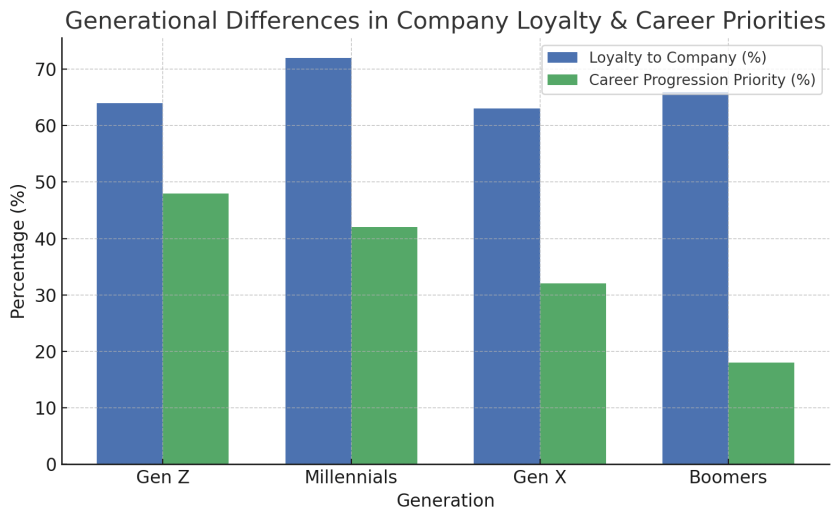
While each generation has its own loyalty patterns, one thing is clear: loyalty is evolving. For Gen Z and Millennials, it’s conditional—based on alignment, growth, and transparency. For Gen X and Boomers, it’s more about consistency and stability. For companies, this means a one-size-fits-all approach to retention won’t cut it. Tailoring strategies to each generation’s values and motivations is key to building a workplace where loyalty isn’t just expected—it’s earned.
 FrogDiva Thoughts