
My relationship with cabbage is tenuous at best. I never liked it as a child and disliked it immensely whenever my mother added it any dish. The only way I managed to eat it (FYI my entire clan was raised on the you-eat-what-is-on-the-table and finish-what-is-on-your-plate principles) was with copious amounts of Maggi liquid seasoning – remember the good old days when that little yellow bottle never left the table and there were at least two backup bottles in the kitchen pantry?
I have a subscription to Equal Food, a company that distributes fruits and vegetables from farms that didn’t quite make the cut for the supermarket aesthetics. You can have the box delivered weekly, or at your convenience. I couldn’t keep up with the weekly portions (too much) so my box arrives every second week and it is always a pleasant surprise to discover what is included. Remember that portion in Master Chef called The Mystery Box where you have to create a recipe based on the ingredients you find in the box? Well it pretty much works that way with me. Some of the vegetables I receive I have never cooked with before, or don’t particularly like, but I know they are healthy so I feel challenged to find a recipe that helps me appreciate it more and overcome my previous dislike.
God bless the people who put this week’s box together, and I know they meant well by celebrating the abundance of nature, but did they really have to include a head of curly cabbage AND a head of red cabbage? Good grief, talk about bio gas explosions galore!
Red cabbage is not something I grew up at all, so I have no basis for recreating a recipe from memory. My journey with red cabbage began in Germany and with German culture. To be precise, in association with a dish of braised duck, Knödel (bread or potato dumplings) and the ubiquitous Rotkohl (pickled red cabbage). I always found the Rotkohl a tad too sour for my liking albeit not as bad as Sauerkraut, and somehow jarring to the senses when the duck and Knödel are wallowing in a sauce.
In the past I usually ran to the supermarket and grabbed a couple of jars of Rotkohl, heated them up in a pan with some apple juice, and maybe added a bit of garlic. I was under the grand illusion that this particular phase of my life of forcible Rotkohl was over and buried once I moved to Portugal, until this week. Not wanting to let good produce go to waste, I scoured the internet for a recipe that appealed to me in the slightest. If I was going to cook the damn thing and eat it myself, might as well make it to my taste. Easier said than done! I eventually found a recipe that did not entail too much vinegar and 4 hours of slow cooking. In doing so, I first had to beg forgiveness from my grandfather’s spirit who always commanded us to follow the recipe to the letter the first time around, and then take the necessary liberties the second time, but I wasn’t sure if there was going to be a second time.
Long story short, I ditched the cloves, doubled the amount of apples, substituted margarine for the required butter, and replaced half of the required vinegar with aged Glühwein (mulled wine), and for the Portuguese twist, a splash of Ginja / Ginjinha (cherry wine). Cooking time was 1.5 hours (the original is two hours, but that makes the cabbage too soggy for my liking) and the house didn’t even smell that bad!
Here is the FrogDiva recipe for Rotkohl and if you are inclined to test it, I’d love to hear from you!
8 – 9 cups red cabbage
2 large apples or 4 small ones
1/3 cup Glühwein (or dry red wine)
1/4 cup apple cider (or homemade pickle juice)
1/4 Ginja (use sweet sherry if you can’t find Ginja)
1/4 cup sugar
1/2 teaspoon salt
1/4 teaspoon pepper
1/3 cup butter (use margarine if making it vegan)
1/4 cup water
1 cinnamon stick
Shred the cabbage, shredding into thin, 1/8″-1/4” thick slices and place in a medium sized heavy pot. Grate the apples and add to the cabbage. In a small bowl add vinegar, water, sugar, cinnamon, salt and pepper. Stir to combine. Pour over cabbage. Add the margarine and cover the pot with a lid. Bring to boil, reduce heat to simmer, and cook for 1 hour. Place in a Mason jar and refrigerate after it has reached room temperature.
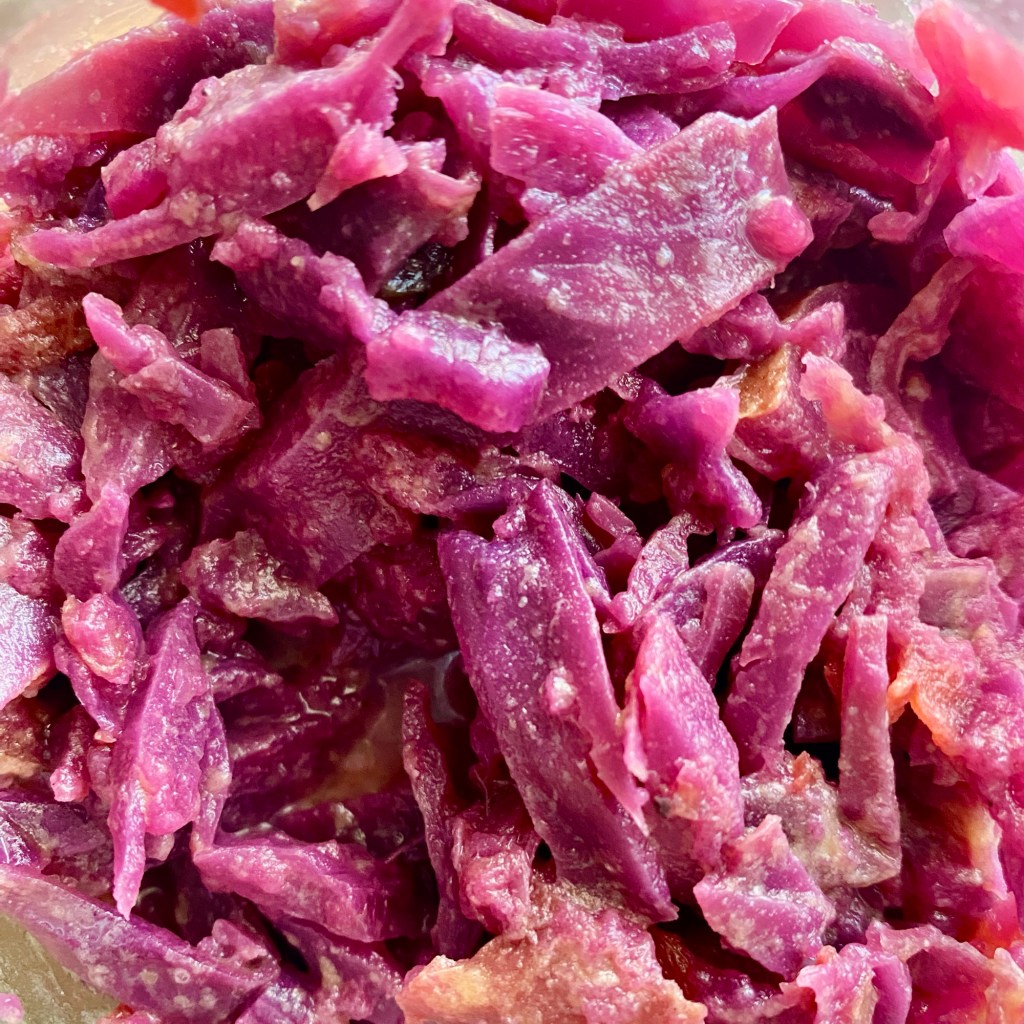
How to serve the Rotkohl is a personal preference. I like it cold, but it is traditionally served warm. My lunch yesterday was an absolutely decadent fusion meal that I thoroughly enjoyed. I had Salsicha Churrasco (fresh sausages for grilling or frying, the local equivalent to the German Bratwurst), slices of fried polenta, and a portion of the cold Rotkohl. For dessert, homemade chocolate pudding and fresh strawberries. Yum!
A note about the polenta: I usually cook a regular portion of polenta and form it into a block and store in the fridge (consume within five days). I then slice off whatever I need and fry it. You can serve the fresh version that resembles mashed potatoes if you prefer, but I like the crispy fried polenta better.
Yes, I have made my peace with the red cabbage, and my grandfather’s spirit has forgiven me, Now I just have to deal with the large head of curly cabbage that keeps glaring at me in the kitchen.
New from The Esoteric Frog:
 FrogDiva Thoughts